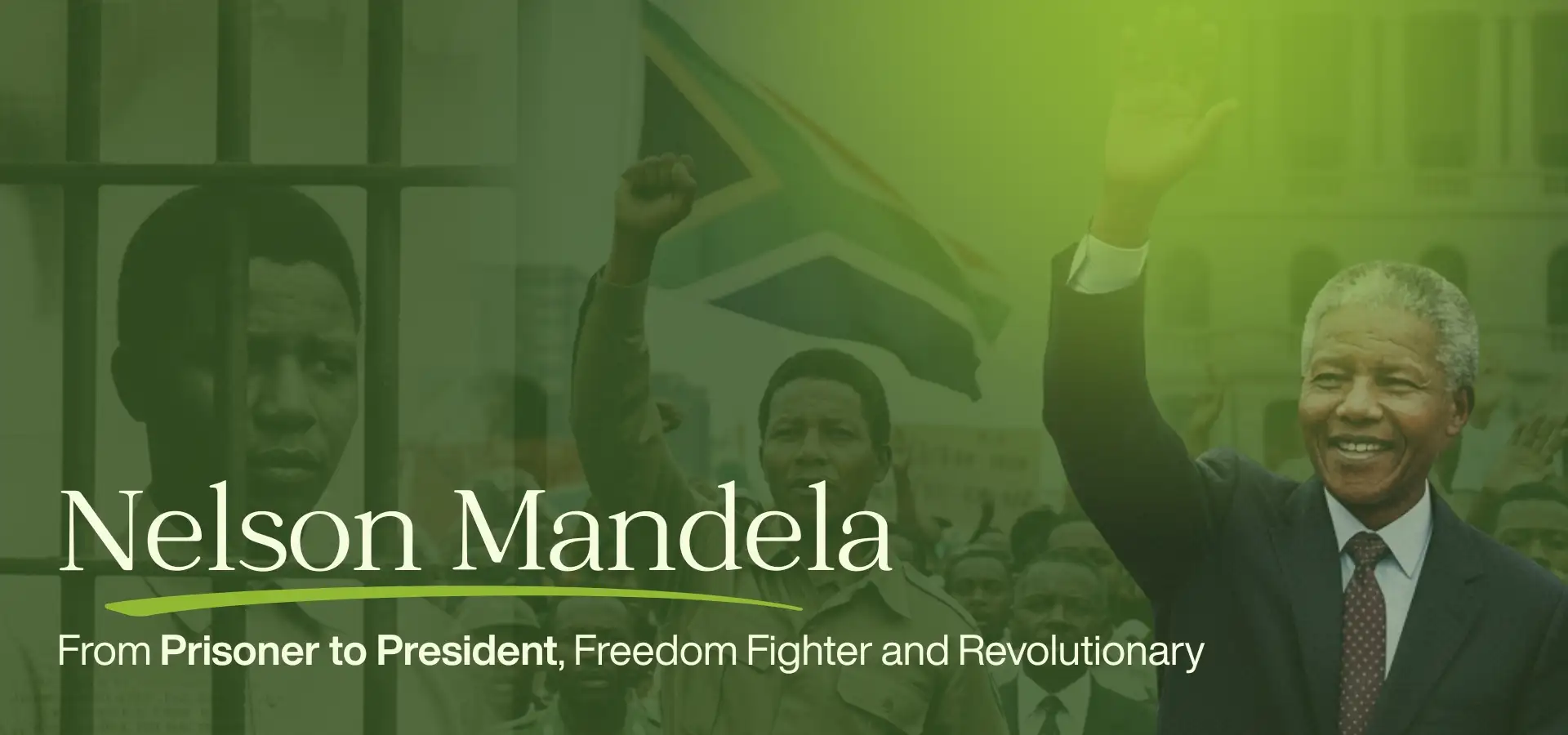
On July 18, 1918, a boy opened his eyes in the royal family of Mrezo Omata, South Africa. When he was seven years old, his teacher gave him the Christian name Nelson, but his father gave him the name Rolihlala, which means Trouble-maker. He went on to become well-known as South Africa's first black president and a legendary liberation warrior. Since Mandela was his grandfather's name, it appears as his last name. Nelson Mandela was the town chief's son. He saw his father's death as well as the period of white brutality and colonization. The town's chief landlord was his father.A white magistrate accused his father Godla Henry of corruption in 1926, and the government seized all of his properties. A few years later, Godla Henry passed away. Nelson also grew impoverished and an orphan.
Guardianship
Nelson was taken in by Chief Jogintaba Dalindyebo following the passing of his father. He brought him up in the same manner as his own kids. When Nelson turned sixteen, Jogintaba arranged for him and his own son Justice to get married in accordance with South African custom. However, the boys refused to get married and left for Johannesburg. He was then given the name Dalibunga.
Personal life
Nelson Mandela married "Evelyn Mase," an ANC activist and trainee nurse, in 1944. Evelyn left him in 1956, claiming that Mandela had physically abused her. Mandela denied the accusations and battled for custody of his children; she later withdrew her separation petition, but Mandela filed for divorce in January 1958. Mandela wed Winnie Madikizela that same year. When he found out about Winnie's liaison with Dali Mpofu, their marriage became more tense, but he stood by her throughout her kidnapping and assault prosecution. She was convicted in June 1991 and given a six-year jail sentence. Mandela made his split from Winnie public on April 13, 1992. On his 80th birthday, on July 18, 1998, Mandela married Graca Machel. Up to 2013, Nelson Mandela's family consisted of thirty members.
Start of struggle
At Johannesburg Nelson's challenging life began. He first worked as a night watchman at Crown Mines before moving on to a low-level corporation as a clerk. where one of his possessions rents him a room. He fell into extreme poverty and led a miserable life. After visiting Johannesburg in 1941 and forgiving Nelson there, Jogintaba passed away in the winter of 1942. Nelson earned his BA from the University of South Africa in 1942 while working during the day and studying at night. Nelson began practicing law after earning his BA.
Despite South Africa's independence from Britain in 1931, Dutch whites, who make up 9% of the country's overall population, reigned over 91% of the country's black people. Following Britain's withdrawal, the Dutch took control of South Africa and wiped out Black people's life. Black people are kept apart from white people in schools, hospitals, buses, and other establishments. Black people are required to keep their identity card and permit pass when traveling between cities.
Mandela's first March
Mandela's first march against local bus fare increases took place in 1943, and it was effective since the bus boycott caused the fare increases to be reversed. Black people were not permitted to vote in 1948 elections, and they were not even granted the chance to cast a caste ballot. There were only two white parties in the field: the National Party, which hated black people and had a superiority complex, and the United Party, which ruled over South Africa starting in 1934. Even church leaders declared that God gave white people the right to rule and black people the right to be slaves, despite the National Party's slogan "The white man always remains Boss." Black people's life were further harmed by the National Party's win and ascent to power.
Malan, the president of the National Party, even declares that "South Africa belongs to us once more" in his victory address. The party that was remembered as the Aparthide party was the same. From the time of their victory until 1994, they ruled South Africa for 46 years. Black-white marriages were prohibited by the Aparthide Party, and population registration was based on color rather than strength. Black people were subjected to discrimination in every aspect. One of their harsher acts was the "Crop Areas Act," which gave white people the right to seize black people's land by simply claiming the region as "white people's area." They also had the power to expel black people from the area.
Black people launched uprisings against these kinds of acts and the white Dutch government's prejudice against their rights. Black people began traveling without passes, entering white areas without authorization, and engaging in numerous other acts of rebellion to express their opposition to white people.
Role of African National Congress
In 1942, Nelson joined the organization African National Congress battled to defend Black rights in South Africa. In 1944, Nelson founded the ANC Youth League. He was elected ANC president in 1951. Nelson was elected as the African National Congress's deputy president in 1952. Blacks revolts were rising by each passing day. Nelson Mandela and 21 other participants in these rebellious acts that incited the African National Congress (ANC) were arrested by the government on July 30, 1952. Nelson and other activists were sentenced to nine months in prison by magistrates at the start of the trial, but this punishment was eventually postponed to two years. The ANC was warned to cease their rebellious actions by this delay.
Nothing could stop the ANC from rising. Nelson and the other 150 individuals were accused with "high treason against state" when the authorities became tired of the ANC's rebellious actions. Nelson Mandela and 150 other campaigners were detained at Johannesburg prison after being seized by police on December 5, 1956. Bile was provided by Nelson and his fellow members four days later. While high treason against state was being dealt with in Johannesburg, Black uprisings and protests were occurring throughout the entire nation. 56 Black people were killed and 156 injured by police in Sharp Valley on March 21.
Martial law was imposed and the African National Congress was banned by the government on March 7, 1956. Nelson and other activists were apprehended by the government once more, and the trial started gradually in 1961. As a result of the world community's pressure on the South African white government to provide Blacks rights, the country severed its links with Britain and became a republic on May 31, 1961. Nelson and his 29 companions were freed on March 29, 1961, because there was insufficient evidence to convict them.
Underground
After being set free, Nelson became an underground crusader for freedom after realizing that Actions speak louder than words. Blacks' rebellious activities were reported while they were in the nation, and they believe that the ANC is inciting people to rebel against the State. In this instance, police actively sought Nelson, but they were unable to locate him. In newspapers, he was referred to as the "black pimpernel" besides to the fictional "Scarlet pimpernal" character. Nelson secretly went to his ANC's covert sessions, where they decided to create armed forces.
Nelson, Sisulu, and Slovo co-founded "Umkhanto we sizwe" (meaning "spear of Nation") in 1961 Abbreviated as MK.Three major South African cities—Johannesburg, Durbar, and Port Elizabeth—were bombed on December 16, 1961. In order to avoid endangering civilians, MK only targeted military installations, power plants, telephone connections, and transportation linkages.
Mandela's Secret Dispatch
Mandela was secretly dispatched by the ANC as a delegation to visit other nations, some of which provided financial assistance and others with weapons. He traveled to Egypt, Tanganyika, and Tunis, where the president granted him $5,000 for weapons. He continued on to Senegal, Guinea, Sierra Leone, Liberia, Morocco, Mali, and Guinea. The president of Guinea and Liberia gave him money. He relocates to London with a diplomatic passport issued by Sinigole's government.
Life in Imprisonment
Nelson Mandela and fellow campaigner Cecil Williams were arrested by police on August 5, 1962, close to Howick. Later on, former American Donald Rickard disclosed that the Central Intelligence Agency (CIA) alerted South Africa's police about Nelson's whereabouts because of his alleged Communist affiliation. Nelson was incarcerated at Johannesburg's Marshal Square Prison. Nelson was accused of organizing a workers' strike and traveling abroad without authorization. Active bombing and aiding the Soviet Union in toppling the state government was another accusation. He relocated to Pretoria, where his hearing started in October.
However, he interfered with the proceedings by wearing a traditional kaross, declining to summon any witnesses, and using his mitigation plea as political rhetoric. In the first case, he was found guilty and sentenced to five years in jail for inciting people against the government and leaving the country without authorization; in the second case, he was condemned to life in prison for bombing and aiding the Soviet Union in overthrowing the government. His court remarks attracted attention from throughout the world, particularly when the phrase "I am prepared to die" was published. There were appeals from all around the world for the accused to be freed from the United Nations and World Peace Council while University of London supporting his presidency.
Mandela and his co-accused were moved from Pretoria to Robbin Island Prison in 1964, where they spent the following eighteen years. Mandela was confined to a small cell and subjected to physical and verbal abuse by a number of white jail guards. Before he was transferred to a lime quarry in 1965, they were compelled to grind rocks into gravel. He was assigned to the lowest-grade prison, which means that throughout his six-month stay, only one person may meet and only one censored letter may be sent. He was not allowed to go to his son's and then his mother's funerals. The government intends to provide Mandela opportunities to flee, but they are unable to carry out this act in public. If Mandela attempts to flee, he will be murdered in an encounter, and the government will be exonerated of all charges.
However, they had two unsuccessful plans. The international world emphasized the need to release Black inmates. Mandela became a Class A prisoner in 1975 as a result. Mandela and other members were moved to Pollsmore Prison in Cape Town in April 1982. Pollsmore Prison's conditions were superior to Robbin Island's. Due to intermediate pressure, the government is softening its stance toward Nelson Mandela. When the ANC carried out 231 attacks in 1986 and 235 in 1987, the anti-aparthide opposition retaliated. Coetsee facilitated talks between Mandela and the four government representatives. In May 1988, the team decided to free Mandela and his associates with the proviso that they would never again use violence, sever ties with the Communist Party, and refrain from demanding a majority.
Mandela objected to these demands, stating that the ANC would only cease its armed operations if the government gave up using violence. The moist state of the cell makes recovering from tuberculosis more difficult. In December 1988, Mandela was moved to the Victor Vorster Prison. Botha was replaced in 1989 by F.W. De Klerk, who released a number of ANC prisoners because he thought apartheid was untenable. That same year, Klerk convened his cabinet to discuss the legalization of the ANC and Mandela's release. Klerk had a cordial meeting with Mandela in December to talk about many issues.
Nelson Mandela released
The government declared in February 1990 that all political parties, which had previously been prohibited, would be legalized, and Nelson Mandela would be freed without conditions. It was the first time his photos had been published in South Africa following 27 years of incarceration. Roads were congested all the way to Cape Town as millions of people welcomed their leader. Mandela and the new administration worked out a deal to hold multiracial elections. Mandela visited India in 1990 and received the Bharat Ratna. Mandela visited Pakistan in 1992 and received the Nishan-e-Imtiaz. Both Mandela and De Klerk visited the United States in 1993, met President Bill Clinton, and were awarded Liberty Medals. Mandela and de Klerk were given the "Noble Peace Prize" in Norway shortly after.
First Black President
South Africa held general elections from April 26 to 29, 1994, marking the first time in the country's history that both Blacks and Whites participated in elections. The National Party won 82 out of 400 seats, while the ANC won 252 out of 400. As Nelson Mandela became South Africa's first black president and De Klerk was appointed vice president, both parties established a new administration. During his presidency, Mandela worked to dismantle the apartheid legal system, create a democratic constitution, mend the nation's wounds, and set the foundation for a more just society—all while maintaining economic stability and gaining South Africa a respected position on the international scene. Mandela released his well-known autobiography "Long Walk to Freedom" in December 1994. He served in the government from 1994 to 1999. Mandela visited Pakistan in 1999, where he spoke to a joint session of parliament and gave a presentation alongside Nishan-e-Quaid-e-Azam.
Retirement
Mandela was retired in 1999 and he present his farewell speech in assembly. He made the decision to move to Quna after retirement. Mandela recovered from prostate cancer in July 2001. The Mandela Rhodes Foundation was established in 2003 at Rhodes House, University of Oxford, to offer South African students postgraduate scholarships. Due to declining health, Mandela declared in June 2004 that he was "retiring from Retirement." "Don't call me, I will call you" is a remark that indicates he wishes to go alone. He limits all external relationships. Mandela's 80th birthday was celebrated nationwide on July 8, 2008.
End of a legend's life
Mandela faced health crisis from 2004.He was sent to the hospital in February 2001 due to a respiratory infection, and he was readmitted in 2012 due to a lung infection and gallstone extraction. However, in 2013, he was readmitted to a Pretoria hospital due to a worsening lung illness. Nelson Mandela's recovery was being prayed for by everyone, but Alass! He passed away on December 5, 2013, at the age of 95. He was laid to rest in a family cemetery in Quna, Eastern Cape, South Africa. Quna is home to the Nelson Mandela Museum. Bill Clinton, Barack Obama, and Bill Gates gave lectures at the Nelson Mandela Foundation, which was established to promote the idea of equality. Mandela remained inspiration to all those who fought for freedom, equality and revolution in the world.
"I have fought against white domination, and I have fought against black domination. I have cherished the ideal of a democratic and free society in which all persons will live together in harmony and with equal opportunities." Nelson Mandela
Frequently Asked Questions
The real name of Nelson mandela was Rolihlala Mandela. He was given the name of "Nelson" by his school teacher, which was later widely famous as Nelson Mandela.
Nelson Mandela became South Africa’s first Black president as the leader of the African National Congress (ANC). After his release from prison in 1990, the ANC won the historic 1994 elections, and Mandela was inaugurated as president.
Nelson Mandela helped found Umkhonto we Sizwe (MK), the armed wing of the African National Congress. Formed in 1961, MK carried out sabotage and guerrilla actions as part of the struggle against apartheid.
Nelson Mandela earned the nickname “the Black Pimpernel” because, like the fictional Scarlet Pimpernel who slipped in and out of danger, he repeatedly evaded the South‑African security forces while organizing anti‑apartheid activities. British journalists coined the term in the early 1960s to highlight his ability to move underground, arrange meetings, and escape capture despite a massive police manhunt. The moniker underscored both his elusiveness and the racial dimension of the struggle—“Black” to contrast with the original “Pimpernel” legend.
Nelson Mandela is most famous for leading South Africa’s fight against apartheid and becoming the country’s first Black president after the 1994 democratic elections. His lifelong commitment to equality, forgiveness, and democracy made him a global symbol of resistance and hope.
Discussion
Leave a Comment