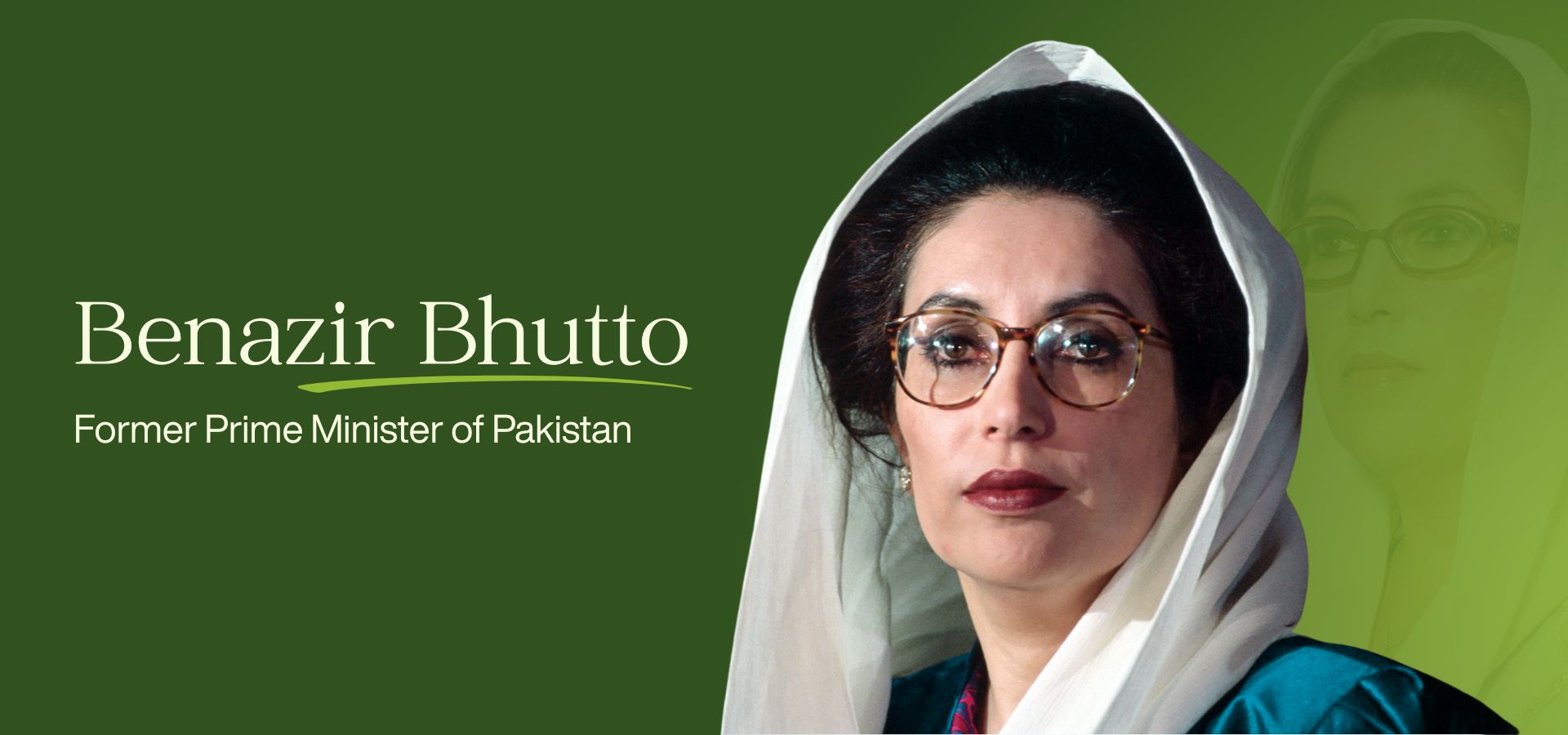
Benazir Bhutto was one of the most iconic and powerful political figures in the history of Pakistan. She was not only the first woman to lead a Muslim-majority country but also a symbol of democracy, courage, and resistance. Her life was filled with achievements, hardships, and sacrifices. From her birth in a political family to her tragic assassination, the story of Benazir Bhutto reflects the deep political struggles of Pakistan.
Early Life and Family Background
Benazir Bhutto was born on June 21, 1953, in Karachi, Pakistan. She belonged to the famous Bhutto family of Sindh. Her father, Zulfikar Ali Bhutto, was one of the most influential politicians in Pakistan. He served as the President from 1971 to 1973 and as Prime Minister from 1973 to 1977. Her mother, Nusrat Bhutto, was of Iranian-Kurdish origin and was also active in politics. Her husband Asif Ali zardari was president of pakistan from September 2008 to September and then he gets re-elected and from March 2023 he is now serves as president of the country. Her Son Bilawal bhutto zardari served as foreign minister of pakistan April 27, 2022 to August 10, 2023 and from December 30,2007 he was acting as chairman of PPP(Pakistan’s people party).
Benazir was the eldest of four children. Her siblings included Murtaza, Shahnawaz, and Sanam Bhutto. She grew up in an environment where politics and public service were regular topics of discussion. Her father played a major role in shaping her political thoughts.
After seeing her father's unfair, biased assassination she made the resolute decision to enter politics and demonstrate that her father was not a criminal and that his murder was motivated by personal prejudices.
Education and Academic Excellence
Benazir received her early education at the Karachi Grammar School. At the age of 16, she went to the United States and attended Radcliffe College at Harvard University. There, she studied comparative government and graduated in 1973 with honors.
After Harvard, Benazir went to the University of Oxford in the United Kingdom. She studied Philosophy, Politics, and Economics (PPE) at Lady Margaret Hall. She later became the first Asian woman to be elected as the President of the Oxford Union in 1977. Her time in Oxford helped her build leadership skills and broaden her understanding of global politics.
Political Awakening and Struggles
Benazir returned to Pakistan in 1977, just before a major political crisis. That year, General Muhammad Zia-ul-Haq overthrew her father’s government in a military coup. Zulfikar Ali Bhutto was arrested and later executed in 1979 under controversial circumstances.
This event changed Benazir’s life forever. She, along with her mother, took over the leadership of the Pakistan People’s Party (PPP). The party faced strong opposition from the military regime. Benazir was placed under house arrest several times and was even jailed. From 1981 to 1984, she lived under strict restrictions.
In 1984, she went into self-exile in London. Despite being away from home, she continued to speak against the dictatorship in Pakistan. In 1986, she returned to Pakistan and led a massive rally in Lahore. Her return gave new hope to the supporters of democracy.
First Term as Prime Minister (1988–1990)
After the sudden death of General Zia in a plane crash in 1988, elections were held. The PPP, under Benazir’s leadership, won the majority. On December 1, 1988, Benazir Bhutto took oath as the Prime Minister of Pakistan.
At the age of 35, she became the youngest Prime Minister and the first woman to lead a Muslim-majority country. Her first government focused on social reforms, women’s rights, health care, and education. She also aimed to reduce poverty and improve public welfare.Benazir hosted a three-day SAARC meeting on December 29–30, 1988, which was a great move towards fostering good relations with India, safeguarding both nations' nuclear assets, and fostering good relations with other Islamic nations. She restored labour and trade unions and freed prisoners. The People Worker Program, which improved the lives of the impoverished, was one of her significant contributions.
Decline of Government
However, her government faced many challenges. She had to deal with a powerful military, a conservative society, and internal party issues. There starts situation get worse in Karachi, refugees were shot dead almost 4000 people died in karachi operation and allegation of this genocide was putted to PPP. In 1990, her government was dismissed by President Ghulam Ishaq Khan on charges of corruption, although the allegations were never proven in court.
Leader of the Opposition and Second Term (1993–1996)
Benazir continued her political journey and remained a strong voice in parliament. In 1993, PPP again won the elections, and Benazir became the Prime Minister for the second time.
Her second term focused on economic reforms and privatization. She worked to strengthen foreign relations and attract investment. She also wanted to make Karachi and other cities' law and order conditions better. In addition, she worked to advance women's rights, enhance literacy, health and care, combat drug trafficking, review foreign policy, build positive ties with India, and take action to resolve the Kashmir dispute.
Challenges and Decline
Despite these efforts, her government once more encountered issues, such as charges of corruption against her husband, Asif Ali Zardari, and nepotism for choosing her husband to lead the gold mine. At that time, they also had to deal with the "Sar-e-Mehal" case, which involved Asif Zardari purchasing apartments in the UK by engaging in corruption in Pakistan. Saudi Arabia was criticising Asif Zardari and calling him "Mr. 10%" for corruption. Tensions increased after her brother Murtaza Bhutto died in a police encounter in 1996. It was believed that Benazir Bhutto and her husband killed Murtaza Bhutto in order to secure their government. She raised taxes in RGST-12 August 1996, and general traders protested the excessive taxes. President Farooq Leghari dismissed her government once more on November 5, 1996.
Years in Exile and Legal Challenges
After her second dismissal, Benazir left Pakistan and lived in self-imposed exile in Dubai and London. During this time, she faced several court cases related to corruption. Some international courts also investigated her and her husband, but many of the cases lacked evidence or were politically motivated.
While in exile, she continued to lead PPP and remained active in international political discussions. She gave lectures and wrote articles on democracy, women's rights, and development.
Return to Pakistan and Assassination
In 2007, under a deal with then-President Pervez Musharraf, Benazir was granted amnesty and allowed to return to Pakistan. On October 18, 2007, she came back and led a massive procession in Karachi. Unfortunately, a suicide attack targeted her convoy, killing over 130 people. She survived that attack.
On December 27, 2007, Benazir Bhutto held a public rally in Rawalpindi. As she was leaving the venue, an assassin fired shots at her and then detonated a bomb. She was rushed to the hospital but was declared dead at 6:16 PM. Her assassination shocked the entire world. Thousands of people mourned her death. Leaders from around the globe paid tribute to her bravery and efforts for democracy.
Legacy and Impact
Benazir Bhutto’s life and political career left a deep impact on Pakistan and the world. She broke many barriers for women in politics. Her leadership gave hope to many people who believed in democracy and human rights.
Though her governments were often criticized for corruption and mismanagement, many of her initiatives in education, health, and women's empowerment laid the foundation for future progress. Her return to Pakistan in 2007 showed her commitment to the people despite the risks.
Benazir Bhutto is remembered today as a martyr for democracy, just as her father was. Her assassination did not end her life; she was a woman whose father served as prime minister, and she served as prime minister twice herself. Her husband currently holds the position of president of the nation, and her son, Bilawal Bhutto Zardari, carries on her political legacy through the Pakistan People's Party, as she cleared the path for her family to be with its people.
Frequently Asked Questions
Benazir Bhutto was the first woman to become Prime Minister of a Muslim-majority country, Pakistan. She served two terms and was a symbol of democracy and women’s empowerment.
She was born on June 21, 1953.
She was assassinated on December 27, 2007.
She led the Pakistan People's Party, became Prime Minister twice, promoted women’s rights, and fought for democracy.
Her legacy includes breaking barriers for women in politics, standing up to military rule, and promoting democratic values in Pakistan.

Discussion
Leave a Comment